
Author: Jeremy Johnson, Agronomist
Nitrogen management has always been a balancing act, but in Ontario’s increasingly variable growing conditions, that balance is getting harder to maintain. Between rising input costs and unpredictable weather patterns, every pound of nitrogen needs to work harder.
For experienced growers, the conversation is evolving. It is no longer just about how much nitrogen you apply. It is about when it is applied, how it is protected, and whether it is still there when the crop needs it.
Early-Season Losses: The Hidden Yield Robber
One of the biggest challenges in nitrogen management is how vulnerable early applications can be. Spring conditions across Ontario often bring periods of excessive moisture followed by rapid drying, creating ideal conditions for nitrogen loss before the crop can use it.
Two pathways tend to dominate:
- Volatilization from surface-applied nitrogen, especially when rainfall is delayed
- Leaching and denitrification under saturated soil conditions
In both cases, the loss happens quietly and early. By the time the crop reaches peak demand, part of the nitrogen investment is already gone.
Shifting the Focus: Timing Over Total Rate
It is tempting to compensate for potential loss by increasing rates, but that approach rarely delivers consistent returns. What matters more is how well nitrogen availability aligns with crop uptake.
Corn, for example, takes up a significant portion of its nitrogen during rapid vegetative growth stages V6-VT. If nitrogen is applied too far ahead of that window without protection, the risk of loss increases.
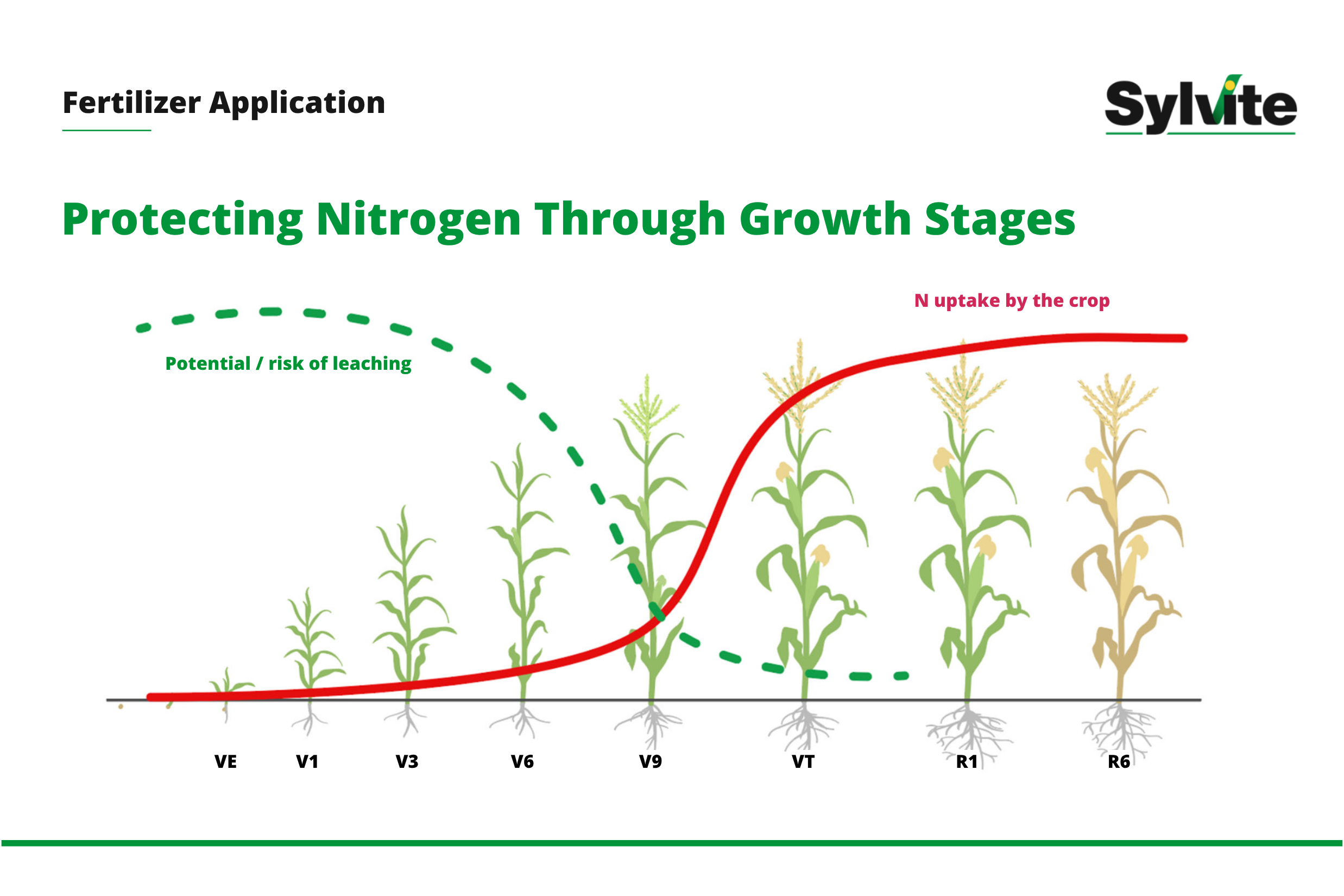
The same principle applies in winter wheat, where early spring applications must support growth without being exposed for extended periods.
A well-timed application, even at a slightly lower rate, often outperforms a higher rate that is poorly aligned with crop demand. This is where staging applications or protecting early applications becomes a practical strategy.
Protection as Part of the Program
Protecting nitrogen is not about adding complexity. It is about reducing risk.
Nitrogen stabilizers work by slowing down the processes that lead to loss. Some products target volatilization, while others reduce the conversion of ammonium to nitrate, which is more prone to leaching and denitrification. In Ontario conditions, where both risks often exist in the same season, having protection on multiple fronts becomes increasingly important.
Where Sylvite’s SylLock Fits
At Sylvite Agri-Services, we look at nitrogen stabilizers as part of a complete program, not a standalone input.
SylLock is designed to provide dual protection, helping to manage both volatilization and leaching risks. This makes it particularly useful in early-season applications, where conditions can shift quickly.
It fits well in situations such as surface-applied nitrogen programs or early spring applications where the crop is not yet actively taking up nutrients. It also complements split-application strategies by protecting the base rate while allowing flexibility later in the season.
Whether your nitrogen program is liquid or dry; SylLock provides protection from early season losses.
Building a More Efficient Nitrogen Strategy
An efficient nitrogen program comes down to three things working together: timing, protection, and placement. When those elements are aligned, nitrogen is more likely to be available when the crop needs it, rather than being lost to the environment.
Ontario growers are no strangers to managing variability. The difference today is that the margin for error is smaller. Protecting nitrogen is not just about maximizing yield, it is about creating consistency across a wide range of seasonal conditions.
As you evaluate your nitrogen program this season, the question is not just how much you are applying. It is whether that nitrogen will still be there when it counts.